
Building a Community Together
From the Desk of Emily S. Hager, Director of Programming & Education
A few weeks ago, I was asked to give some feedback towards a group of student’s research projects about World War II and the Holocaust. During the email exchange, I kept it in the back of my mind that those students were going to visit the museum in approximately two weeks, and the teacher requested to have the students give a presentation about their research projects during the field trip. I read through the students’ research choices carefully, and all their choices were so diverse and compelling. Topics ranged from teenage spies, Auschwitz, and even deaf/hard of hearing experiences during WWII.
After the teacher introduced me as an “expert” on the Holocaust I offered the students some guidance. My feedback varied from observations like, “I like the background photo you picked!” to more specific research topics they could incorporate into their projects. One group was researching the Warsaw Ghetto, and I suggested to the students to look up the story of a local Holocaust survivor named Wanda Wolosky who lived in the Ghetto, and to relate Wanda's story back to what they learned.
Then the day came for the students to come to the museum. As I assisted the teacher with set up, I remarked just how professional the middle school poster projects were! When the final project was set up for display, I wandered around the posters to see what everyone learned. Then I saw it: a poster on Wanda Wolosky. I was elated.
In that moment, I was reminded how important it is to connect with our neighbors, our community, and our schools, to build a better tomorrow. The size of the gesture doesn’t matter—what matters is taking the time to listen, to share, and to engage with one another.
That insight came to fruition once more over the weekend. Last Saturday, December 6th, TJMHC was invited to participate in the Frontier Holidays at the Presidio Museum. Despite being a native Tucsonan, I had never actually been to the Presidio Museum before. I loved how the building directly integrated history, showing the progression that occurred over time. As children and I watched the cannon fire, smiles wide and ears covered, we were all in awe.
Back at the TJMHC table, kids stopped by to learn a little bit about Hanukkah, and more importantly to them, how to play dreidel to win candy. Our docent, Nancy, would talk to the parents about the museum while the kids cleaned me out of my chocolate gelt. Throughout the afternoon, I spoke with people who not only appreciated Tucson’s history but were eager to learn more and help keep it alive.
These experiences reaffirm the power of community in keeping history alive. When educators, families, cultural institutions, and curious learners come together, we create spaces where stories can be heard and remembered. I’m grateful to be part of that effort and excited for the continued partnerships that will shape the future of our shared history within Tucson.
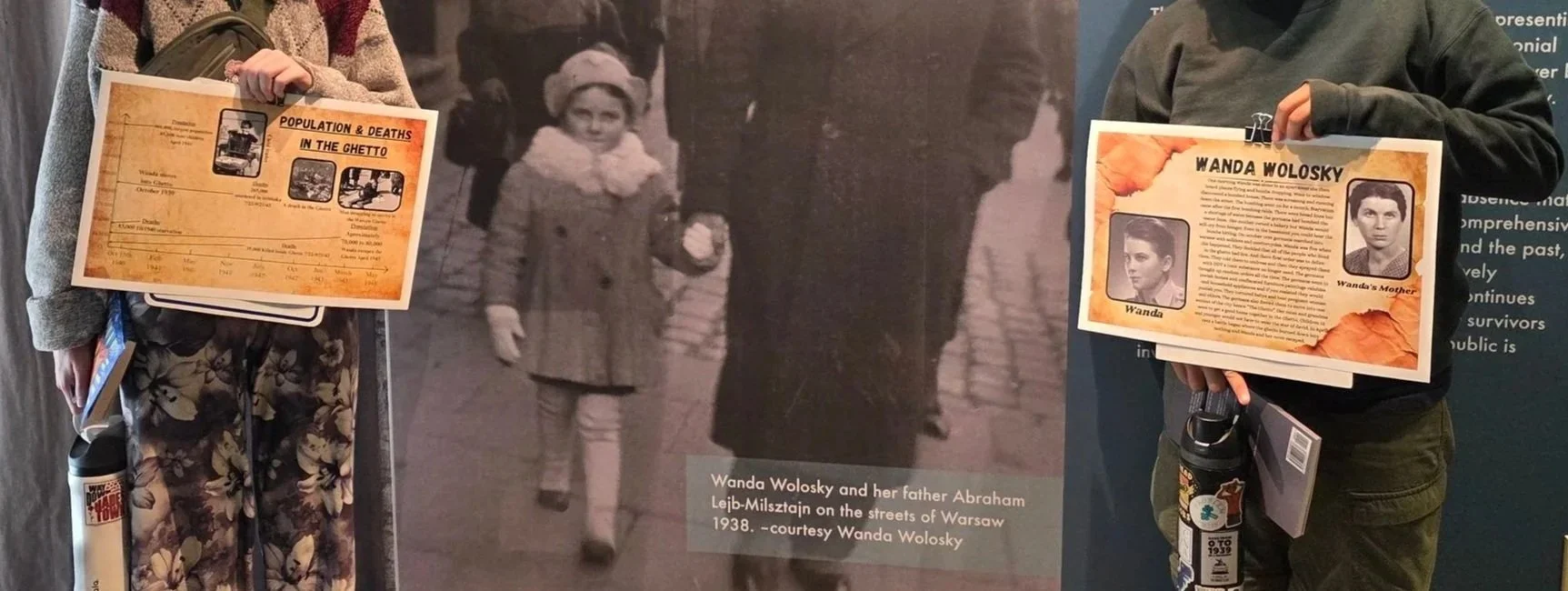
Students holding their research projects on Wanda with Intimate Histories exhibit in the background.