
Falkenberg Faces the Future
Guest blog post by Jim Dannenberg
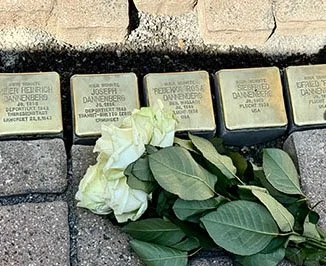
Stolpersteine or “stepping stones,” laid in memory of Dannenberg family members who perished in the Shoah
Falkenberg is a village of perhaps 750 souls in northern Hessen, just one of many tiny rural towns south of the larger German city of Kassel. The green rolling landscape, dotted with farms and forests, reminds me of the countryside in Wisconsin, where I grew up.
In June, 2025, Falkenberg celebrated its 775th anniversary. Jews were first allowed to live in Falkenberg around 1700, and my ancestors shared 122 years of that history. For most of that time, Jewish Falkenbergers lived in relative harmony with their Christian neighbors, but that changed with the rise of the Nazis. The Jewish community of Falkenberg, which once numbered more than one hundred, disappeared completely soon after the pogrom of November 1938, often referred to as Kristallnacht, when the local synagogue was destroyed and the town’s remaining Jews were terrorized.
Forty-two Jewish Falkenbergers were murdered in the Holocaust. The rest were forced to flee.
In June of last year, five distant cousins from my extended family, all fourth- or fifth-generation Americans and mostly strangers to each other, met in Falkenberg to lay Stolpersteine, “stumbling stones,” in memory of relatives who were murdered or expelled by their neighbors.
The flight to Frankfurt from San Francisco went well. My wife, Susan Erickson, and I managed to drive the hour or so north, mostly on tiny country roads, to our hotel in Hesserode, a little town next to Falkenberg (which has no accommodations), by mid-afternoon. Thank goodness for GPS. We met one cousin there, Marilyn MacKay, who had also just arrived, we had a very nice dinner, and went to bed.
The local historian with whom I'd been working, Thomas Schattner, met us at the hotel for breakfast the next morning and had an interesting agenda for us. Along with another visiting cousin, Anne Sterling, and her spouse, Paula Vogel, we first drove to the neighboring town of Felsberg-- maybe a mile or two away-- to visit the only operating synagogue in the area. When I visited the area thirty years ago, the building that had housed the synagogue until 1938 was a pizza parlor. But with a grant from the EU, the few local Jews had managed to completely renovate it, and the reform congregation now has about 35 members who come from the surrounding area, which includes the larger city of Kassel. Of course, most of these are more recent immigrants, as the original pre-1938 Jewish population was murdered or exiled. Apparently this is the only non-orthodox congregation in the area. No rabbi, but they have a cantor. Their security is pretty tight, and recently the front was egged by suspects unknown. Since the neo-nazi Alternativ für Deutschland (AfD) party is strong in Hessen, the security is warranted.
Along the way, Thomas showed us small memorials for Felsberg victims of the 1938 Kristallnacht pogrom and for one of the planners of the 1944 assassination attempt against Hitler.
The main activity of the day was the opening of an exhibit in Falkenberg showing the history of the Jewish community before 1938. Until then, Jews accounted for about 20 per cent of the population. The exhibit was on the second floor of the only commercial building in town, the Gansemarkt Cafe, a new and charming little place to shop and have coffee and cake. The opening attracted quite a few townspeople, plus several local politicians. Thomas and I made opening remarks, and the politicians gave short, supportive, and sometimes emotional speeches.
Afterward, the young mayor of Falkenberg, Samuel Waldeck, volunteered to drive us to the town's Jewish cemetery, located in a copse of trees that could be reached only by driving across a farm field. I had visited the cemetery a couple of times in the 1990s. Back then it was untended and in poor condition, with lots of broken headstones, but now it was properly maintained by the town. We found the graves of Dannenberg ancestors, though the headstones were often in Hebrew and badly weathered. Thesetting was quite peaceful.
The next day we laid five Stolpersteine on the street in front of the house at Am Schlossberg no. 8, where my ancestors and relatives had lived from 1835 until 1938. Two stones memorialized Dannenbergs who were murdered in the Shoah and three represented the last Dannenberg residents who were lucky enough to flee to America in 1938. The brass-faced, engraved stones were fashioned and laid by 78-year-old Gunter Demnig, an artist who first conceived the memorial project in the 1990s. Since then, more than 100,000 stones have been laid in almost every European country to memorialize the Jews, Roma, gay, and disabled people murdered or forced into exile by the Nazi government.
The installation, on an uncomfortably hot afternoon, took perhaps an hour and was attended by at least 50 or 60 townspeople of all ages. Gunter Demnig, as was his custom, installed the five stones silently, as others conducted the ceremony. Thomas Schattner made some opening remarks, and then my wife Susan read an excerpt, in German, from the Book of Ezekiel. I made my remarks, which Thomas translated, and the mayors of the town and of the wider community gave short, moving speeches. Another cousin, Wendy Kane, who was there with her sister, Kerrie Schwartz, read the Kaddish, the Mourner's Prayer, in Hebrew. Finally, the young pastor from a neighboring town's Protestant church spoke in German and in English. There were few dry eyes at the conclusion.
Though two police officers had been posted at the end of the street, the town's reception couldn't have been more friendly and understanding. Lots of young people attended and seemed genuinely horrified at the events we memorialized. A ninety-year-old Christian woman from the town handed me two photos taken at her parents' 1930 wedding and pointed out Siegfried Dannenberg in attendance. Everyone seemed comfortable with this delayed reckoning with the past. Many placed stones or flowers on the Stolpersteine. After the ceremony the new owners, a youth-oriented nonprofit, invited us on a tour of the 300-year-old Dannenberg house and then to their headquarters on the other side of town for drinks and cake. We were all quite moved by their hospitality. Somehow the world seems to be a more dangerous place than it did just a few years ago, mostly because of the rise of far-right nationalism in both Europe and America. Not everyone looks upon the period between 1933 and 1945 as one of darkness. In the 1930s Hessen was a center of Nazi support, giving Hitler as much as 44 per cent of the vote. During the recent German elections the AfD still garnered about 25 per cent in Falkenberg. The good news is that they came in third. Whether any of the AfD voters attended the Falkenberg ceremonies I cannot say, but it didn’t seem likely. I doubt that I’ll ever get back to Falkenberg, given my age, but it lightens my heart a bit to know that I would be welcomed if I did—and that my family has not been forgotten.