
Therese Marx-Ferrin
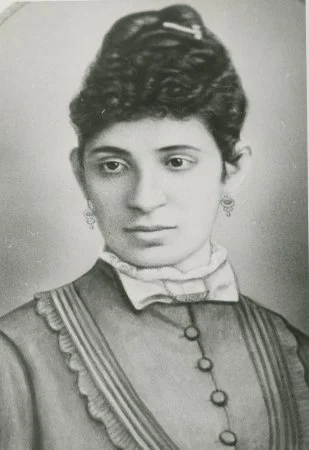
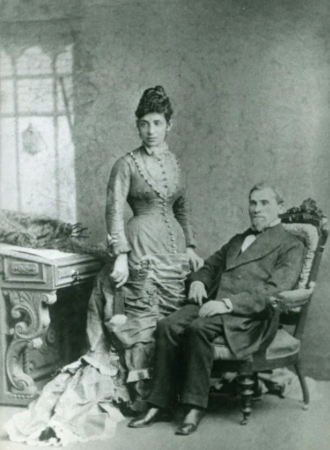
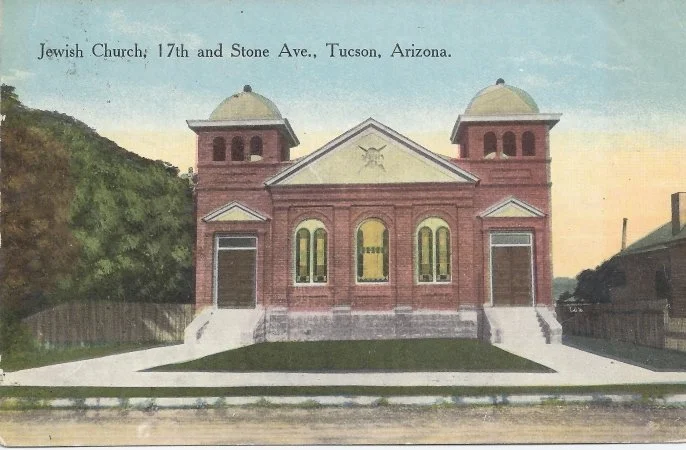
From left to right: Therese Marx-Ferrin (unknown date), Therese and Joseph Ferrin (1878), Postcard depicting Temple Emanu-El (1914)
Therese Marx-Ferrin was a founding member of the Hebrew Ladies Benevolent Society, a sisterhood that played a vital role in establishing Temple Emanu-El, the historic synagogue that now houses Tucson Jewish Museum.
Therese Marx was born in Frankfurt, Germany, on June 26, 1846. Much of her early life in Germany is unknown, but she was able to immigrate to the United States in 1878. She arrived in San Francisco, California, and met her husband, Joseph Ferrin, that same year. She worked as a milliner, or hat maker, for a short period of time before the couple decided to move to Tucson, Arizona. There, Therese and Joseph would establish their home in an area that would later become known as Barrio Viejo, and they developed into well-respected members of the local Jewish community.
Therese and Joseph also went on to have many successful children born and raised in Barrio Viejo. Their first child was Hattie, born in 1879, and she would eventually marry Charles Solomon, also the child of a Jewish pioneering couple, Isadore Elkan Solomon and Anna Freudenthal-Solomon. The next child to bless the Ferrin household was Clara, born in 1881, and she was a dedicated teacher in Tucson for many years. Therese and Clara would have many things in common. Lastly, Therese and Joseph would welcome their last child, Arthur, in 1884.
Additionally, in 1884, a group of Tucson women came together with the shared goal of forming an organization to aid members of the community in need. After six weeks of planning and collaboration, the Hebrew Benevolent Society was formed, with Therese Ferrin listed among its founding members.
The group changed names multiple times throughout their tenure, but the dedication to their mission of helping those in need never faltered. Two years later, in March 1886, the Hebrew Ladies Benevolent Society hosted what was described by the Tucson Citizen as “the most brilliant social event to ever transpire in Tucson,” a Purim ball. The ball was a great success, and the money that was raised allowed the Hebrew Ladies Benevolent Society to continue its mission of assisting local Tucsonans in need.
Therese’s dedication to the organization was further demonstrated in 1887, when she was elected President of the Hebrew Ladies Benevolent Society. She served multiple terms, reflecting both her leadership abilities and her deep commitment to Tucson’s Jewish community.
Then, in March 1904, a new sisterhood– the Hebrew Ladies Aid Society– was formed. This organization would eventually become the Sisterhood of Temple Emanu-El and played a key role in establishing the first Jewish synagogue in the Arizona Territory. Therese is cited as being the first President of the Hebrew Ladies Aid Society. Early endeavors of the Aid Society included becoming formally organized with monthly meetings, membership dues, as well as creating philanthropic and civic objectives. Therese remained the President of the Hebrew Ladies Aid Society for at least another three terms.
Like many of her sisters, Therese was also involved in a variety of organizations in addition to the Hebrew Ladies Aid Society. For example, Therese served on the Board of Directors for the Arizona Health League, along with her daughter, Clara Ferrin-Bloom. The Arizona Health League helped aid those who had fallen ill– particularly with tuberculosis– a common ailment found in Arizona during the late 1800’s to early 1900’s. In addition to supporting patients during their recovery at home, the organization helped patients secure employment once they regained their strength. On a more whimsical note, Therese was heavily involved with a local whist club and often hosted the card games in her own home. This knack for playing cards– and oftentimes winning card games– was also passed down to her daughter Clara.
Therese was 63 years old when, on October 24, 1909, she put an advert in the local newspaper, Arizona Daily Star, urging the Jewish residents of Tucson to attend a meeting regarding the construction of the synagogue. The meeting took place in the Ferrin home, showing that even at an advancing age, she was determined to see Temple Emanu-El built. In March 1910, Therese hosted yet another meeting in the Ferrin home, and in this meeting, the Articles of Incorporation were drawn up for the Hebrew Benevolent Society to become an official, legally recognized organization. Therese was elected as one of the Directors during this meeting, showing just how well admired and respected she was among her peers.
Her devotion came to fruition on June 20, 1910, when the first cornerstone for Temple Emanu-El was placed by masons of Lodge 4 Tucson. Only a mere five months later, the Temple was officially opened for High Holy Day Services on Erev Rosh Hashanah, October 3, 1910.
On February 25, 1911, Therese passed away at the age of 64. Her funeral was held in Temple Emanu-El, where her friends, her fellow Hebrew Benevolent Society sisters, and family paid respects and honor to her life. An outpouring of tributes, some anonymous, surfaced in local newspapers shortly after her death and funeral. Her legacy and lasting impact are still honored to this day, especially in Barrio Viejo, where both the Ferrin house and Temple Emanu-El are still standing and occupied. Temple Emanu-El, now Tucson Jewish Museum, is less than half a mile from Therese and Joseph Ferrin’s house on the corner of South Meyer Avenue and West Cushing Street, and is noted as being the fourteenth historical landmark on the Tucson Turquoise Walking Trail.
Plaza of the Pioneers: Dedication, by Tucson Museum of Art, 1982
Arizona Daily Star
Tucson Citizen
Bloom Southwest Jewish Archives (University of Arizona)
Arizona Historical Society file MS 1475, a Biography on Therese by Clara Ferrin-Bloom
Photo credits: Arizona Historical Society, Tucson Citizen, TJMHC Archives